
Identifying jewelry
Found old jewelry? How to tell what it is and what it's worth
Inherited jewelry or found a ring in a drawer? Read the stamps, check the stones, date the piece and estimate its value before you sell or insure it.
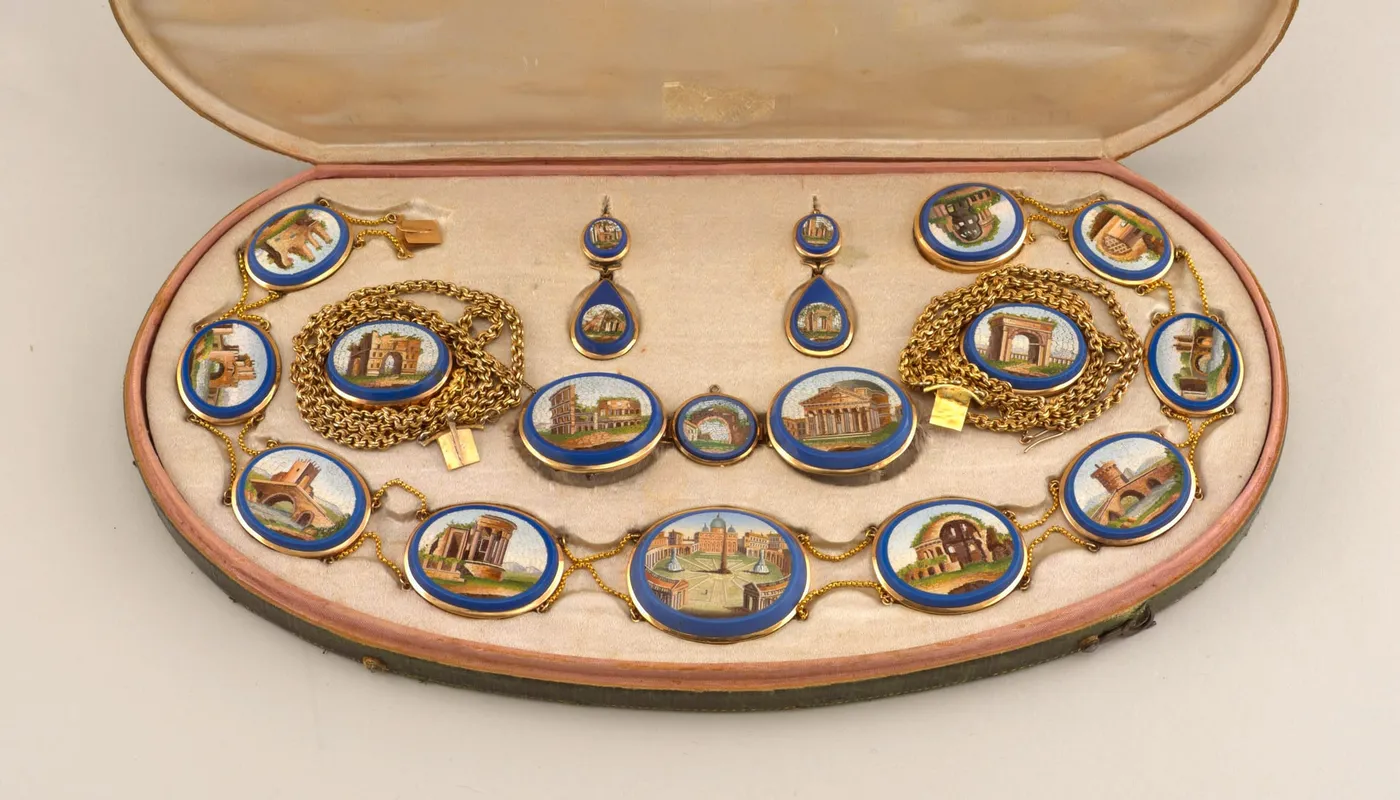
A jewelry box from a grandparent, a ring at the back of a drawer, a brooch from an estate sale. Most people who find a piece like this ask the same two questions: what is it, and is it worth anything?
You can answer a lot of both at home, with good light, a magnifier and about fifteen minutes. This guide walks through the order a jeweler would follow.
Before you start: don’t clean it yet
It is tempting to polish a dull piece first. Wait. Harsh cleaners can damage pearls, opals, emeralds and old foil-backed stones. On antique pieces, the original finish adds value. Wipe off dust with a soft dry cloth and leave the rest for later.
You will need:
- Daylight or a bright white lamp
- A magnifier: a 10x jeweler’s loupe is ideal, but your phone camera zoomed in works too
- A small magnet, such as a fridge magnet
- Your phone, to take photos as you go
Step 1: Look for stamps
Most gold, silver and platinum jewelry is stamped with its purity. Look inside ring bands, on the clasp or the tag next to it on necklaces and bracelets, on earring posts, and on the back of brooches and pendants. The marks are tiny, so use the magnifier.
| Stamp | What it means |
|---|---|
| 375 or 9K | 9 karat gold (37.5% gold) |
| 417 or 10K | 10 karat gold |
| 585 or 14K | 14 karat gold |
| 750 or 18K | 18 karat gold |
| 916 or 22K | 22 karat gold |
| 925 or STER | Sterling silver |
| 800 | Silver, common on older European pieces |
| 950, PT950 or PLAT | Platinum |
| GF, GP, RGP, HGE or EP | Gold-filled or plated: a thin gold layer over another metal |
Next to the purity mark you may find a maker’s mark, such as a name, initials or a small logo. A signature like Tiffany & Co., Cartier or Van Cleef & Arpels can multiply a piece’s value, so note any name you see.
No stamp does not mean no value. Very old pieces, handmade pieces and resized rings often lost or never had a mark.
Step 2: Test the metal with a magnet
Gold, silver and platinum are not magnetic. If the magnet grabs the body of the piece, it is a base metal, probably steel or nickel, with plating on top.
Two caveats: clasps often contain a steel spring, so test the chain or band itself, not the clasp. And a non-magnetic piece can still be brass or plated copper, so the magnet only rules things out.
Look at the edges and high points too. Plated jewelry wears through where it rubs, showing a different color underneath, often silver-grey or coppery.
Step 3: Look closely at the stones
For each stone, note its color, its cut, and how it is held in place.
- Clear stones could be diamond, white sapphire, cubic zirconia, moissanite or glass. Our guide to telling a real diamond at home is coming in the next post.
- Colored stones could be precious gems, cheaper look-alikes or glass. A deep red stone might be ruby, garnet or glass, and they look different under magnification.
- Pearls that feel slightly gritty when rubbed gently against your front tooth are usually real, cultured or natural. Fake pearls feel perfectly smooth.
Check the setting. Fine stones are usually held by metal prongs or a metal rim. Stones that are glued in, or set in a closed metal back, are more often costume pieces, with one exception: some Georgian and Victorian jewelry used closed backs too, which brings us to dating.
Step 4: Work out roughly how old it is
Style and construction details date a piece surprisingly well.
| Era | Clues to look for |
|---|---|
| Victorian (1837–1901) | Rose-cut diamonds, seed pearls, black jet or onyx mourning jewelry, lockets with hair inside, a simple C-shaped catch on brooches |
| Edwardian (1901–1915) | Platinum, delicate lace-like filigree, lots of small diamonds and pearls |
| Art Deco (1920s–1930s) | Geometric shapes, platinum or white gold, small square-cut colored stones in lines, old European cut diamonds |
| Retro (1940s) | Bold, chunky designs in rose and yellow gold, large synthetic rubies and sapphires |
| Mid-century and later | Textured yellow gold, clip-on earrings, modern brilliant-cut diamonds, laser-inscribed stones |
Old diamonds are cut differently from modern ones. If the stone looks chunkier, with a small flat circle visible at the bottom when you look straight down through it, it may be an old mine or old European cut, which points to before about 1930.
Step 5: Scan it with an app
Once you have looked at the piece yourself, a scan pulls the clues together. Take a sharp photo in good light against a plain background and run it through Jewelry Identifier Appraisal.
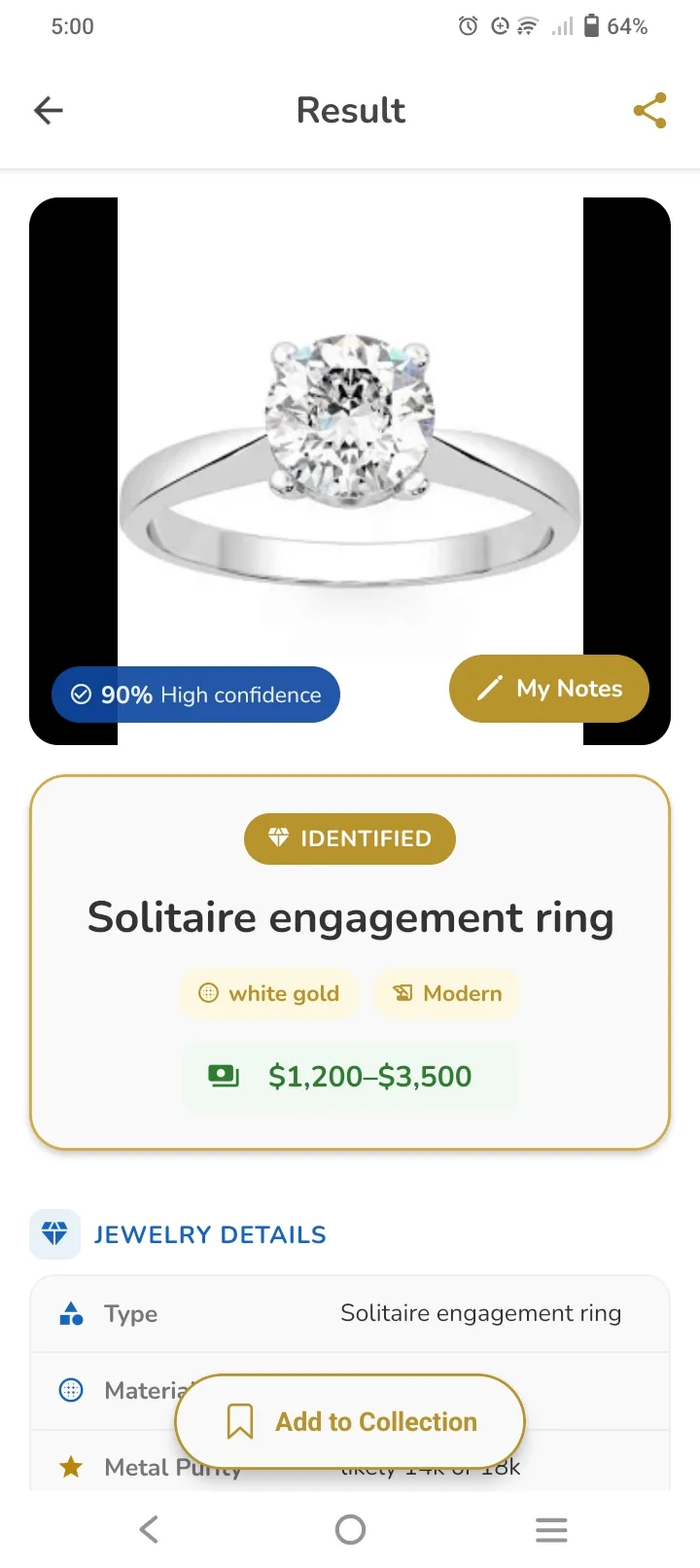
The result names the type of piece, the likely metal and purity, the stones and how many there are, the setting, the era, and the visible condition. It also tells you how confident it is and what to check next. With Premium, each scan adds an estimated value range and resale potential.
Treat the scan as a well-informed first opinion. A photo cannot weigh a piece or test a stone, so the next step for anything that looks valuable is still a professional.
Step 6: Understand which “value” you need
A single piece of jewelry has several different values, and mixing them up is the most common surprise when people try to sell.
- Melt value is what the metal alone is worth: weight in grams × purity × the day’s gold price. It is the floor. A gold buyer will usually pay a little under it.
- Resale value is what a jeweler, dealer or private buyer will actually pay. For ordinary modern jewelry it is often well below the original store price.
- Retail or insurance replacement value is what it would cost to buy a similar piece new. Insurance appraisals use this, which is why they are usually much higher than any offer you will get when selling.
Antique, signed or unusual pieces are the exception. They can sell for far more than their metal and stones, especially at auction.
Step 7: Decide what to do with it
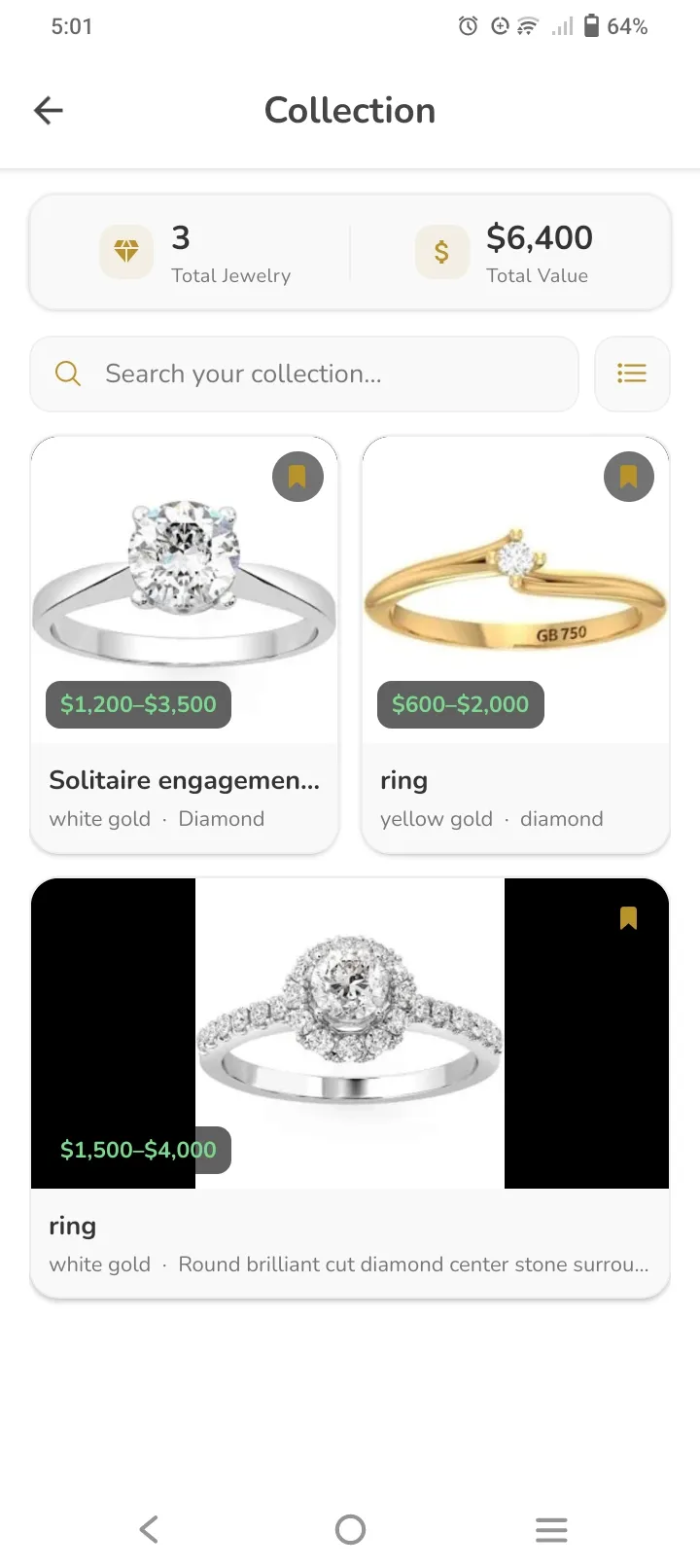
Keep it. Photograph it, note any stamps, and add it to a list of what you own. The app’s collection keeps the photos, notes and estimated values together, so you can see the total value of everything you have.
Insure it. For anything worth more than a few hundred dollars, ask a certified appraiser for a written appraisal. Look for credentials from the GIA, the American Society of Appraisers or a national gemmological association.
Sell it. Get at least two offers. A local jeweler or gold buyer is fastest for plain gold. For antique or signed pieces, ask an auction house or an antique jewelry dealer first, since a gold buyer will only pay for the metal.
The short version
- Don’t clean it yet.
- Find the stamps and any maker’s name.
- Use a magnet to rule out base metal.
- Note the stones and how they are set.
- Date it from its style and construction.
- Scan it to pull the clues together.
- See a professional before you sell or insure anything valuable.
Everything you can do at home, including an app scan, gives you an estimate, not a certified appraisal. For a sale, insurance or anything of real value, confirm with a qualified appraiser or gemologist.